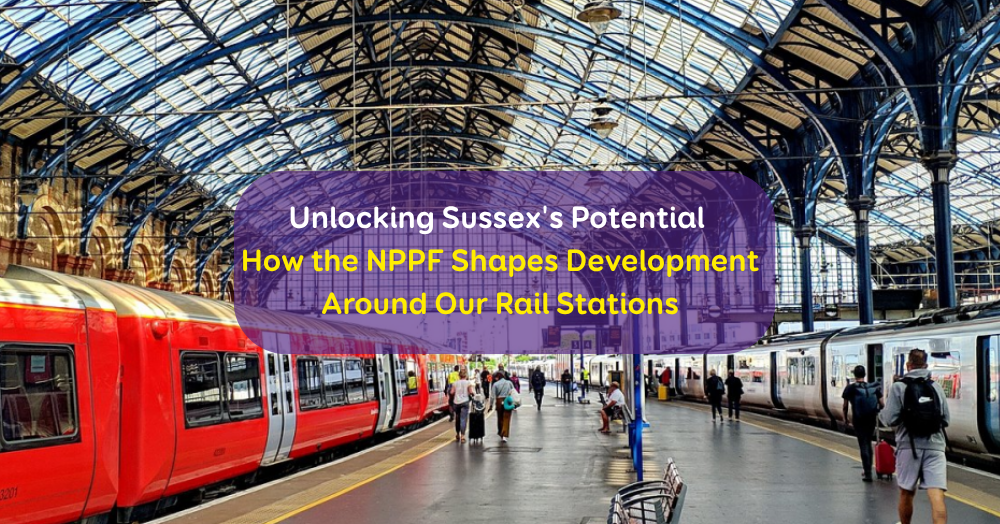
Unlocking Sussex's Potential: How the NPPF Shapes Development Around Our Rail Stations
The National Planning Policy Framework (NPPF) serves as the cornerstone of planning policy in England, guiding local authorities and developers on how to approach new construction and regeneration. For property owners and investors across Sussex, understanding the NPPF's specific stance on development around rail stations is particularly pertinent, given the county's reliance on public transport and its numerous strategic locations.
The NPPF's Core Principles for Sustainable Transport
At its heart, the NPPF promotes sustainable development, and a key aspect of this is encouraging patterns of development that reduce the need to travel by car. Rail stations are identified as prime locations for new development due to their inherent connectivity. The framework encourages local planning authorities to:
- Locate significant development where it can be made sustainable, by reducing the need to travel and offering a genuine choice of transport modes.
- Actively manage patterns of growth to make the fullest possible use of public transport, walking, and cycling.
- Prioritise development that is well-located in relation to existing or proposed public transport infrastructure.
This means that areas immediately surrounding Sussex's main stations, from Chichester in the west to Hastings in the east, and its smaller suburban stations, are often earmarked as suitable for higher-density, mixed-use developments. This approach aims to maximise the efficiency of existing infrastructure and foster vibrant, accessible communities throughout the county.
Sussex Context: A Focus on Connectivity Across the County
For Sussex, a county with diverse transport challenges and a commitment to sustainability, these NPPF guidelines are highly relevant. Areas around key transport hubs, such as Brighton Station, Worthing Station, Eastbourne Station, and even smaller commuter stations like Shoreham or Lewes, are seeing or are set to see considerable regeneration. The NPPF provides the strategic backing for local plans that seek to:
- Increase housing density within walking distance of stations, providing homes for those who can commute sustainably.
- Encourage commercial and retail spaces that benefit from high footfall and excellent transport links.
- Improve public realm and pedestrian access, making it easier and more pleasant for people to access stations and surrounding amenities.
Investors should note that properties within these 'transport hubs' often command a premium due to their desirability and the potential for future growth. The long-term vision, guided by the NPPF, is to create self-sufficient neighbourhoods where residents can live, work, and access leisure facilities without heavy reliance on private vehicles, enhancing connectivity across Sussex.
Challenges and Opportunities for Property Owners
While the NPPF provides a clear direction, its implementation can present both challenges and opportunities for existing property owners and those looking to invest in Sussex. Challenges might include:
- Increased competition for land: As these areas become more desirable for development, land values can rise.
- Impact of construction: Major development projects can cause temporary disruption to local areas.
- Design considerations: New developments must adhere to high standards of design and integrate well with the existing urban fabric.
However, the opportunities are significant:
- Enhanced property values: Proximity to well-connected transport hubs generally leads to higher property values and rental yields.
- Regeneration benefits: Investment in infrastructure and public spaces can revitalise entire neighbourhoods.
- Demand for rental properties: Areas around stations are highly attractive to commuters, ensuring a steady demand for rental accommodation.
At Oakley Property, Chris Oakley and Steven Harvey have many combined years advising clients on how planning policies might affect specific properties or investment strategies across Sussex. Understanding the local plans, which interpret the NPPF for various districts within Sussex, is key to making informed decisions.
Looking Ahead
The NPPF's emphasis on development around rail stations is a strategic move towards creating more sustainable, connected, and vibrant communities. For Sussex, this means a continued focus on leveraging our excellent rail links to foster growth and improve the quality of life for residents throughout the county. Property owners and investors who stay abreast of these planning policies and their local application will be best positioned to capitalise on the evolving landscape of our region.
To discuss the potential in your site or property contact Steven or Chris on 01273 688882 or email steven@oakleyproperty.com / chris@oakleyproperty.com